HKUST Develops First AI Toolkit "GrainBot" to Automate Quantitative Microstructure Analysis
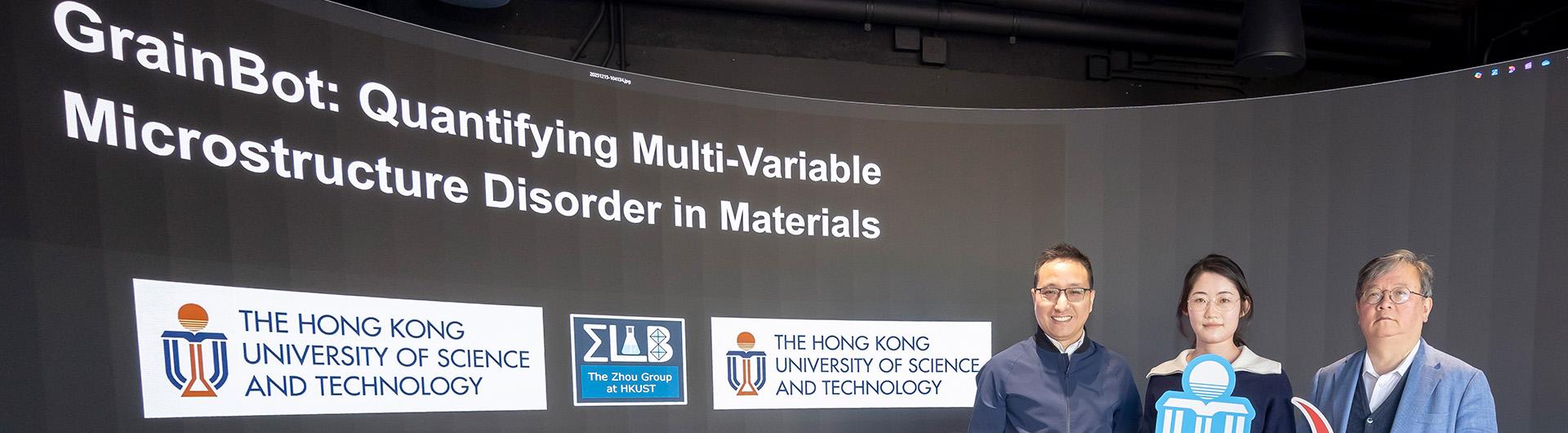
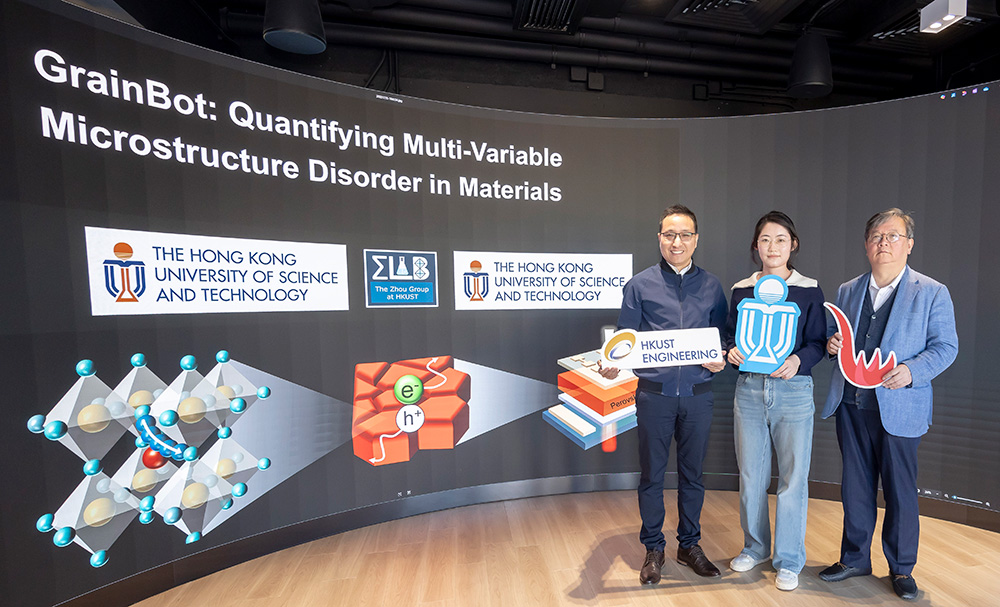
Prof. Yike GUO, Provost and Chair Professor in the Department of Computer Science and Engineering, together with a research team led by Prof. Yuanyuan ZHOU, Associate Professor in the Department of Chemical and Biological Engineering at HKUST, has developed GrainBot, an AI-powered toolkit that helps scientists analyze microscopic images of materials more efficiently.
Modern microscopes can capture very detailed images, but turning those images into useful data has always been a challenge. GrainBot solves this by automatically identifying and measuring tiny features—such as grain size, surface grooves, and shapes—within materials. This allows researchers to build large, standardized databases instead of relying only on visual inspection.
The team tested GrainBot on perovskite thin films, which are important for making high-efficiency solar cells. By analyzing thousands of grains, the toolkit revealed new insights into how different microstructural features interact, such as the relationship between grain size and surface roughness.
Beyond solar cells, GrainBot can be applied to other thin-film materials, offering a powerful framework for advancing materials science.
The research, titled "GrainBot: Quantifying Multi-Variable Microstructure Disorder in Materials", has been published in Matter, a flagship journal of Cell Press.
(This news was originally published by the HKUST Global Engagement and Communications Office here.)