Providing Implications for Instant Biocompatible Surgical Glues: HKUST Engineering Uncovers Key Mechanism of Liquid-Liquid Phase Separation
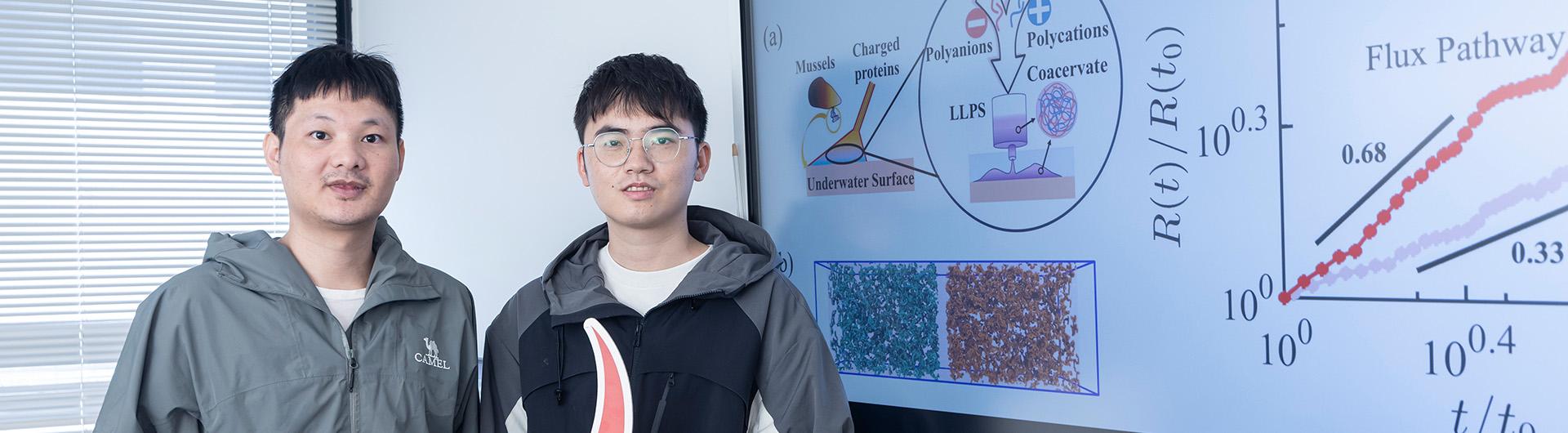
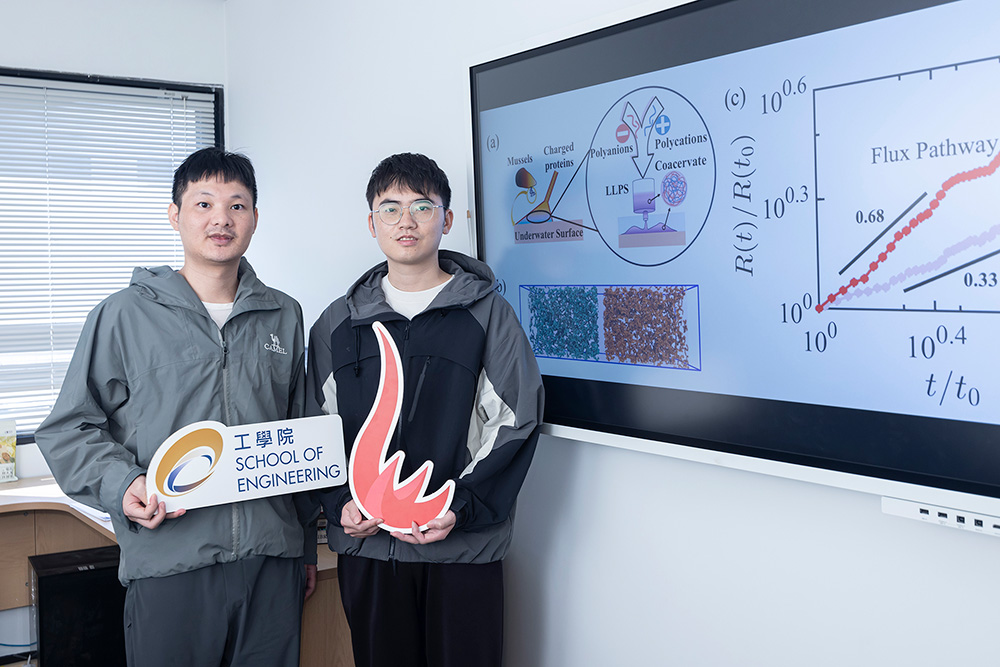
Prof. Shensheng CHEN, Assistant Professor of the Department of Chemical and Biological Engineering at HKUST, and his PhD student Zongpei WU, in collaboration with Prof. Zhen-Gang WANG, Dick and Barbara Dickinson Professor of Chemical Engineering at California Institute of Technology, have uncovered the secret behind how mussels can instantly glue themselves to rocks, even against the force of powerful ocean waves.
The Mystery of the Super-Fast Mussel Glue
Have you ever wondered how mussels manage to stick to wet rocks in under 30 seconds? Scientists have long been puzzled by this natural feat. In a laboratory, creating a similar bond through a process called liquid-liquid phase separation (LLPS) can take minutes or even hours. A research team at The Hong Kong University of Science and Technology (HKUST) has finally solved this mystery, paving the way for innovations like instant, body-safe surgical glues.
Cracking Nature's Code
Using a powerful, custom-built simulation platform, the researchers were the first to model the entire process from start to finish. They discovered that nature uses a special "Flux Pathway" to mix molecules right at the target spot. This method creates an electrochemical "superhighway" that dramatically speeds up the bonding process.
The difference in speed is staggering. The team's simulations showed that forming a half-centimeter adhesive droplet using nature's method takes only 10 seconds. In contrast, conventional laboratory techniques would require an astonishing 47 years to achieve the same result.
From Mussels to Medicine
This breakthrough fundamentally changes our understanding of how certain materials are formed. Prof. Chen explained, "Nature has been our ultimate inspiration. By simulating the entire process, we have moved beyond theory to demonstrate how nature achieves such remarkable speed."
This discovery provides a practical blueprint for creating materials that can assemble on demand. The most exciting applications include the development of instant, biocompatible surgical glues that could be used inside the human body and programmable "smart materials" for a variety of advanced technologies.
This work, published in Nature Communications in the title of “Mixing protocols determine liquid–liquid phase separation dynamics in polyelectrolyte complex coacervation” builds on the team's previous foundational research that rewrote the old rules of how charged polymers behave.
(This news was originally published by the HKUST School of Engineering here.)